|
The Boston Tea Party, 1773
Victory in
the French and Indian War was costly for the British. At the
war's
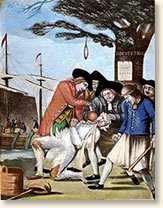
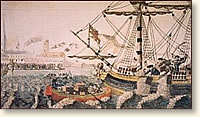
The colonists were not fooled by Parliament's ploy. When the East India Company sent shipments of tea to Philadelphia and New York the ships were not allowed to land. In Charleston the tea-laden ships were permitted to dock but their cargo was consigned to a warehouse where it remained for three years until it was sold by patriots in order to help finance the revolution. In Boston, the arrival of three tea ships ignited a furious reaction. The crisis came to a head on December 16, 1773 when as many as 7,000 agitated locals milled about the wharf where the ships were docked. A mass meeting at the Old South Meeting House that morning resolved that the tea ships should leave the harbor without payment of any duty. A committee was selected to take this message to the Customs House to force release of the ships out of the harbor. The Collector of Customs refused to allow the ships to leave without payment of the duty. Stalemate. The committee reported back to the mass meeting and a howl erupted from the meeting hall. It was now early evening and a group of about 200 men, some disguised as Indians, assembled on a near-by hill. Whopping war chants, the crowd marched two-by-two to the wharf, descended upon the three ships and dumped their offending cargos of tea into the harbor waters. Most colonists applauded the action while the reaction in London was swift and vehement. In March 1774 Parliament passed the Intolerable Acts which among other measures closed the Port of Boston. The fuse that led directly to the explosion of American independence was lit. Take your tea and shove it. George Hewes was a member of the band of "Indians" that boarded the tea ships that evening. His recollection of the event was published some years later. We join his story as the group makes its way to the tea-laden ships: "It was now evening, and I immediately dressed myself in the costume of an Indian, equipped with a small hatchet, which I and my associates denominated the tomahawk, with which, and a club, after having painted my face and hands with coal dust in the shop of a blacksmith, I repaired to Griffin's wharf, where the ships lay that contained the tea. When I first appeared in the street after being thus disguised, I fell in with many who were dressed, equipped and painted as I was, and who fell in with me and marched in order to the place of our destination.
In about three hours from the time we went on board, we had thus broken and thrown overboard every tea chest to be found in the ship, while those in the other ships were disposing of the tea in the same way, at the same time. We were surrounded by British armed ships, but no attempt was made to resist us. ...The next morning, after we had cleared the ships of the tea, it was discovered that very considerable quantities of it were floating upon the surface of the water; and to prevent the possibility of any of its being saved for use, a number of small boats were manned by sailors and citizens, who rowed them into those parts of the harbor wherever the tea was visible, and by beating it with oars and paddles so thoroughly drenched it as to render its entire destruction inevitable." References: How To Cite This Article: We would like to acknowledge and thank www.eyewitnesstohistory.com for this account of the actual Boston Tea Party - Lapeer Tea Party Patriots |
 conclusion
in 1763, King George III and his government looked to taxing the
American colonies as a way of recouping their war costs. They
were also looking for ways to reestablish control over the
colonial governments that had become increasingly independent
while the Crown was distracted by the war. Royal ineptitude
compounded the problem. A series of actions including the Stamp
Act (1765), the Townsend Acts (1767) and the Boston Massacre
(1770) agitated the colonists, straining relations with the
mother country. But it was the Crown's attempt to tax tea that
spurred the colonists to action and laid the groundwork for the
American Revolution.
conclusion
in 1763, King George III and his government looked to taxing the
American colonies as a way of recouping their war costs. They
were also looking for ways to reestablish control over the
colonial governments that had become increasingly independent
while the Crown was distracted by the war. Royal ineptitude
compounded the problem. A series of actions including the Stamp
Act (1765), the Townsend Acts (1767) and the Boston Massacre
(1770) agitated the colonists, straining relations with the
mother country. But it was the Crown's attempt to tax tea that
spurred the colonists to action and laid the groundwork for the
American Revolution.